


When a Particle Count Problem Isn’t Really a Particle Problem
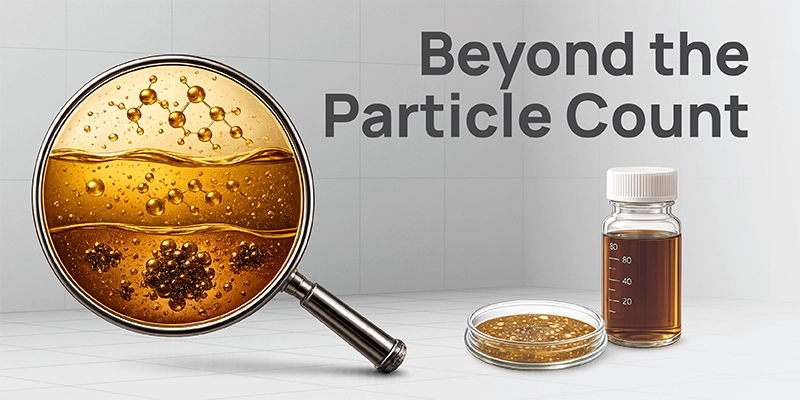
In a Lubricant Shortage, the Most Expensive Oil Change May Be the One You Did Not Need
For years, lubricant decisions in many industrial plants followed a familiar pattern. If oil analysis showed a high particle count, the assumption was straightforward: the oil was dirty. The response was equally familiar: improve filtration, change filter elements, bring in a filter cart, or, if the numbers did not improve, consider replacing the oil.
In a normal supply environment, that approach may have felt conservative. In today’s environment, it can be costly.
When lubricant supply is tight, every oil change carries more consequence. Replacing a large turbine, hydraulic, or compressor oil reservoir is not simply a maintenance decision. It consumes valuable inventory, creates disposal cost, increases downtime exposure, and may force a plant to use replacement oil that is difficult, delayed, or expensive to source.
That does not mean operators should ignore particle count alarms. It means they need to understand what the particle count is telling them before they react.
A high ISO 4406 or NAS cleanliness reading may indicate dirt, wear debris, rust, fibres, or other hard particulate contamination. In those cases, mechanical filtration is the correct response. But in varnish-affected lubricants, a high particle count may be something else entirely.
It may be a chemistry problem presenting itself as a particle problem.
That distinction is more important than ever. When lubricants are scarce, draining oil due to a mistaken particle count can be costly. The real question isn’t just, “How do we eliminate these particles?” but rather, “Are these particles true contamination, or are they varnish-related materials forming because the lubricant chemistry has become unstable?” That is where the diagnosis changes. And when the diagnosis changes, the solution changes with it.
A Particle Count Is a Clue, Not a Diagnosis
High particle counts in turbine oil are usually treated as a straightforward contamination issue. The logic seems simple: if the ISO 4406 or NAS cleanliness level is too high, the oil must contain too many particles, so the solution should be better mechanical filtration.
But in varnish-affected oils, that assumption can be wrong.
A recent technical case showed something unusual but highly important: the oil’s particle count increased dramatically as it cooled, yet the problem largely disappeared when it was reheated. In other words, the “particles” were not behaving like normal dirt, wear debris, rust, or hard contamination. They were temperature-dependent soft varnish particles formed from dissolved oxidation products.
This changes the entire troubleshooting approach.
The particle counter was not wrong. It was doing what it was designed to do under the test conditions. But the result was interpreted as a conventional particulate contamination problem when the root cause was degradation of lubricant chemistry.
That is the difference between reacting to a number and understanding the condition behind it.
The Hidden Link Between Varnish and Particle Counts
Lubricating oil begins degrading the moment it enters service. Heat, oxygen, pressure, water, and time all contribute to oxidation and chemical breakdown. These reactions create polar degradation products, often referred to as varnish precursors.
This chemical breakdown is ultimately one of the root causes of lubricant failure.
At normal operating temperature, many oxidation products can remain dissolved in the oil. The fluid may appear visually acceptable. It may even show relatively low particle counts when tested at high temperatures. However, as the oil cools, its ability to hold those oxidation products in solution decreases. The dissolved material can then precipitate, forming soft varnish particles suspended in the oil.
An optical particle counter can count those soft particles, which may give the impression of cleanliness issues.
ISO 4406 reports particle counts at ≥4 μm(c), ≥6 μm(c), and ≥14 μm(c). Each increase in ISO code generally represents about a doubling of particle concentration. While ISO 4406 identifies the number and size range of particles, it does not identify whether those particles are hard dirt, wear debris, fibres, or precipitated soft varnish material.
That distinction is critical.
A high particle count caused by hard particulate contamination should respond to mechanical filtration. A high particle count caused by temperature-driven varnish precipitation may not.
Even when lubricant supply is abundant, this misunderstanding remains a problem. When lubricant supply is constrained, it becomes a much bigger problem because it can push maintenance teams toward unnecessary oil changes
Why Particle Counts Can Increase When Oil Cools
The counterintuitive mechanism is that dissolved oxidation products can form measurable particles as the oil temperature decreases.
Varnish is not only a hard deposit on metal surfaces. It can exist in both soluble and insoluble forms, and the balance between those forms changes with temperature.
At higher temperatures, the more soluble form is favored. At lower temperatures, insoluble varnish particles and deposits are more likely to form.
This explains why some turbine oil samples can show a major discrepancy in particle count between room temperature and elevated temperature. At room temperature, soft varnish particles may be present and counted. At elevated temperature, the same material may redissolve, causing the particle count to drop.
That means the cleanliness number varies with the sample’s temperature.
For maintenance teams, this is an important warning. A high particle count in a cooled sample does not necessarily mean the system is heavily contaminated. It may mean the oil contains dissolved oxidation material that is no longer staying in solution.
The issue is not simply contamination. The issue is lubricant instability.
Why Better Mechanical Filtration May Not Solve the Problem
When particle counts increase, the natural response is usually to filter the oil more intensively.
That response makes sense if the problem is hard particulate contamination. Mechanical filtration is designed to remove particles physically present in the oil as it passes through the filter. If the oil contains dirt, wear debris, rust, or fibres, filtration can be highly effective.
But if the root cause is dissolved oxidation material, mechanical filtration has a limitation.
A particle filter cannot remove material that is dissolved in warm oil. Even if some soft varnish particles are captured after cooling, the dissolved varnish precursors remain in the lubricant. As operating conditions and temperatures change, those precursors can continue to precipitate, generating new soft particles.
This is why simply tightening the micron rating may not solve the problem. A better filter does not necessarily correct unstable oil chemistry.
In this case, a high-efficiency mechanical filtration cart was added after particle counts increased. The cart featured a fine filter, yet the cleanliness issue remained. The root cause became clear: the system was not addressing stable, hard particles. Instead, it was handling oxidation material that could be dissolved at one temperature and could exist as soft particles at a different temperature.
That presents a very different issue and calls for a different approach.
Why ICB® Solved a Particle Problem
The surprising outcome in this case was that an ion-exchange resin-based technology solved what appeared to be a particle-count problem.
At first, that may seem counterintuitive. Ion exchange resin is generally understood to be a dissolved contaminant removal technology, not a particle filter.
But that is exactly why it worked.
EPT Clean Oil’s patented ICB® ion-exchange technology targets the soluble, polar oxidation products that lead to varnish formation. By removing dissolved varnish precursors, ICB reduces or eliminates the material that would otherwise precipitate as soft particles upon cooling.
This is the key technical insight: ICB did not merely remove particles after they formed. It removed the dissolved material that formed those particles.
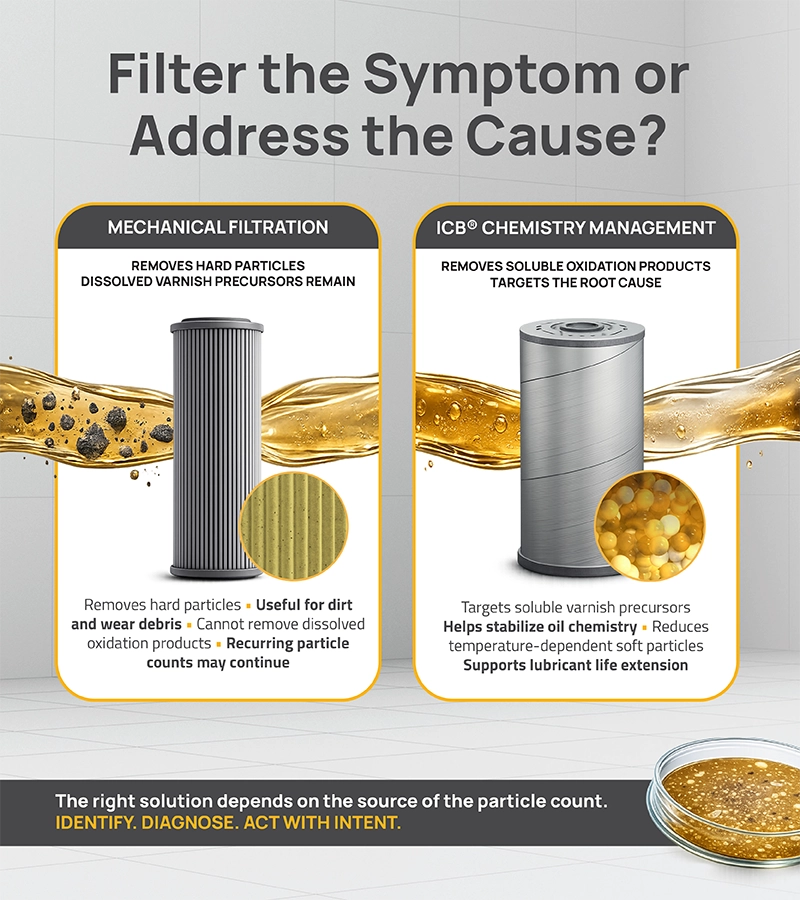
In bench-scale treatment, soft varnish particles at room temperature were almost eliminated. More importantly, the large difference between 20°C and 60°C particle counts was reduced to approximately one ISO code after ICB media removed varnish material that was dissolved at 60°C but insoluble at 20°C.
That matters because it confirms the root cause.
The issue was not simply that the oil contained particles. The issue was that the oil contained oxidation products that could shift between dissolved and insoluble states as temperature changed.
By addressing the soluble varnish precursors, ICB helped stabilize the oil chemistry and prevent the recurring formation of soft varnish particles.
That’s why EPT Clean Oil refers to the overall strategy as Lubricant Chemistry Management.
The objective is not only to chase cleanliness codes. The objective is to understand and control the chemistry that determines whether the lubricant remains stable, clean, and fit for service.
What Maintenance Teams Should Do Before They Drain the Oil
A high particle count should always be taken seriously. But it should not automatically trigger the assumption that the oil is contaminated with hard particles or that replacement is the only answer.
Before consuming scarce replacement lubricant, maintenance teams should ask a few practical questions:
- Was the sample tested hot or at room temperature?
- Does the particle count change significantly when the same oil is heated?
- Has fine mechanical filtration failed to improve cleanliness?
- Is the system showing other signs of varnish potential, such as elevated MPC values, membrane discoloration, rising acid number, antioxidant depletion, or recurring deposits?
- Does the oil history suggest oxidation stress, thermal degradation, or long service life?
If the particle count is high at room temperature but much lower when heated, that is strong evidence of temperature-dependent soft varnish precipitation. If fine filtration has failed to resolve the issue, that is another sign the problem may not be conventional particulate contamination.
In those cases, the next step should not be to keep tightening filtration or rush toward a full drain. The next step should be to investigate the lubricant’s chemistry.
That is especially important in turbine oils, hydraulic systems, compressors, and other critical applications where large lubricant volumes are expensive to replace and may be difficult to source quickly.
A Better Way to Think About Cleanliness
Traditional oil maintenance often separates contamination into two categories: particles and dissolved degradation products.
In many applications, that distinction is useful. Hard particles damage surfaces and can be removed by mechanical filtration. Dissolved degradation products contribute to varnish, sludge, acidity, additive depletion, and deposits.
However, the two categories can overlap.
Dissolved oxidation material can become particulate contamination as temperature changes. A dissolved-contaminant problem can therefore present itself as a particle count problem.
That means the correct solution depends on identifying the source of the particles, not simply reacting to the ISO or NAS number.
If the particles are dirt or wear debris, mechanical filtration is appropriate.
If the particles are soft varnish generated from dissolved oxidation products, then the oil chemistry must be corrected.
ICB addresses the source by removing soluble varnish precursors before they convert into insoluble particles. This helps interrupt the repeated cycle of precipitation, filtration failure, recurring high particle counts, and premature oil replacement.

The Larger Point: Extend Oil Life by Understanding the Cause of Failure
The lubricant shortage has made one thing clear: industrial operators need to get more value from the oil already in service.
That does not mean blindly extending oil life, ignoring oil analysis results or delaying necessary maintenance. It means making better decisions based on better diagnoses.
A particle count problem may be a filtration problem. It may also be a varnish chemistry problem.
Knowing the difference can help maintenance teams avoid unnecessary oil changes, preserve lubricant inventory, reduce downtime risk, and protect critical equipment.
That is the value of Lubricant Chemistry Management. It shifts the conversation from “How clean is the oil?” to “Why is the oil failing, and can we correct the cause before replacement becomes necessary?”
In a supply-constrained market, that question matters. Not every particle count problem is truly a particle problem.
And when lubricant is scarce, the most expensive oil change may be the one you did not need.