


The Relative Lifetime Costs and Savings Associated with Varnish-Removal and Mitigation Technologies
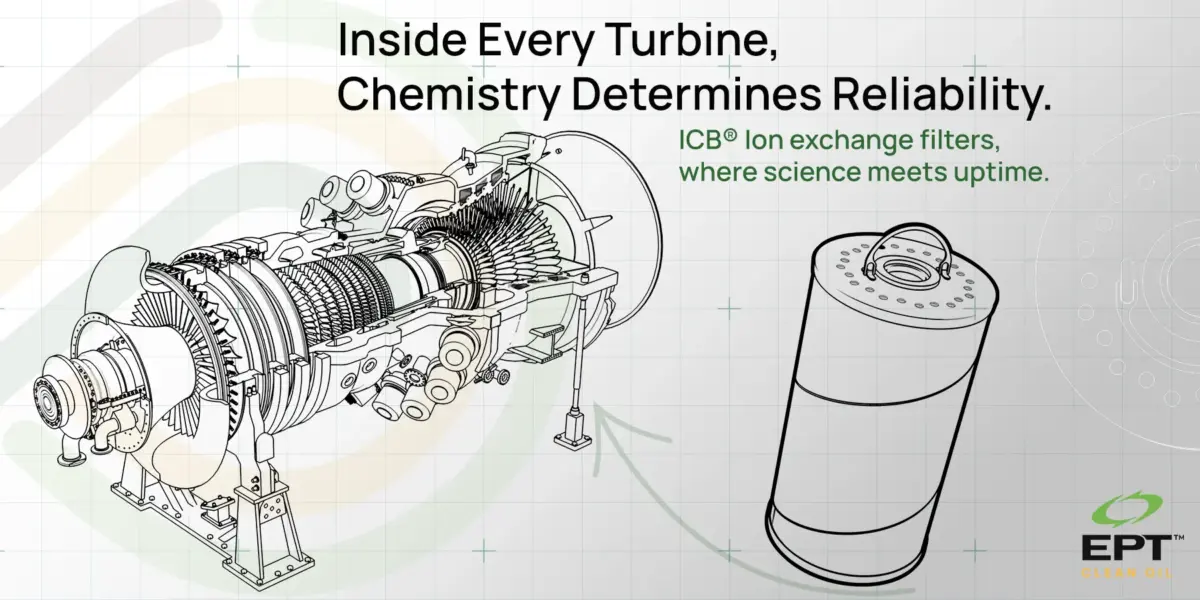
Nearly half of the power generated in the US every year is produced by gas turbines, and their importance with respect to meeting the world’s energy needs is growing as less efficient coal-fired power plants are phased out. Industrial gas turbines are, therefore, critical infrastructure and their reliability is paramount. Thanks to their sophisticated engineering, many gas turbines now boast reliabilities that exceed 99%. GE’s family of 176 MW Frame 7F turbines, for instance, are reported to have an industry-leading 99.3% reliability.
The True Cost of Gas Turbine Varnish
Despite these impressive claims, a 99.3%-reliable system will, nevertheless, be down 0.7% of the time. On an annual basis, this represents a production loss of 61 hours. EPRI has reported that 54% of “forced (turbine) outage hours” are the result of oil contamination.4 Even the 99.3% reliable Frame 7F turbine will, therefore, experience an average of 33-hours of avoidable oil-related downtime annually. At a conservative average wholesale price of $40/MWh,5 this amounts to an average annual loss of $232,320, which, in turn, represents up to $5.8 million in avoidable losses over the turbine’s 25-year lifetime.
As the most common cause of oil-related downtime in gas turbines, varnish is the single greatest contributor to these losses. As a result, numerous varnish-removal or mitigation strategies have been developed. These include: aftermarket chemicals (AMCs), depth filtration, and ICB® ion-exchange filtration. Despite the high costs associated with varnishing, many gas turbine operators fail to recognize the value that varnish-removal and/or mitigation can add to their operations; Sadly, a $45,000 capex for an effective varnish-removal system is viewed as a luxury, while a $232,320 annual loss is seen as normal.
To fully appreciate the economic benefit of varnish mitigation/removal, this paper will outline the total cost of ownership for three leading technologies and compare them with the costs of failing to address varnish over a turbine’s complete 25-year lifespan. Given the magnitude of the reliability-related losses described above, it will come as no surprise that the costliest thing any gas turbine operator can do is nothing at all.
Explore the data, science, and lifetime economics behind ICB ion-exchange filtration and lubricant chemistry management, and request the full technical paper below.